

Speech Clarity Milestones: When to Seek Help
If your child talks—but other people can’t understand them as well as you should, mispronounces many sounds, stutters, or struggles to express thoughts clearly—you’re not alone. Every child develops at their own pace, but early guidance matters.
At Powers Pediatrics in Orlando, FL, we help families through Growth & Development concerns with supportive, family-centered pediatric care—screenings, guidance, and referrals when needed.
You can also ask about Speech Clarity Guidance via Telemedicine.
Speech clarity vs. “talking”: what parents should know
Speech clarity issues can show up in different ways:
Articulation / pronunciation
sounds are difficult to make (or many sounds are mispronounced)
Fluency
stuttering/repeating (“uh-uh,” “I-I-I…”) or getting stuck while speaking
Expressive language
trouble putting thoughts into words (short sentences, vague words)
Pragmatics / Social Communication
difficulty using language appropriately in conversations (turn-taking, staying on topic, understanding back-and-forth)
A child may be social and engaged, yet still be hard to understand—or they may become frustrated or avoid speaking. These signs are exactly what we help families assess.
What’s normal (and what’s common) at different ages
Below are general expectations. Children can vary, especially in bilingual homes or if they’re slow to warm up. But milestones are still useful for deciding when to ask for help.
By ~6 months
- You should usually hear babbling (even if it’s not “words” yet).
- Consider checking sooner if your child rarely babbles or doesn’t seem to respond to sounds.
Around 12–15 months
- Many children have a few words (even if imperfect).
- Consider speaking with your pediatrician if there are no words by this time, or if communication seems to be going backward.
By ~18 months
- Many toddlers use several words and start combining sounds/gestures to communicate.
- If other people consistently can’t understand your child’s words, it may be time to evaluate speech clarity and hearing.
Around 2 years
- Speech is often still developing; intelligibility (how much strangers can understand) is typically limited at this age.
- Many children begin combining words into short phrases.
- Seek guidance if your child has very few words, doesn’t combine words, or seems stuck expressing needs.
Ages 3–4 years
- Strangers should understand your child most of the time, and speech should become progressively clearer.
- You may still hear some sound errors, but overall intelligibility improves.
- If your child is still very hard to understand, or errors remain very consistent, ask about a referral.
School-age years (5+)
- Speech should be clearer with age.
- Stuttering or speech effort that affects participation at school is a key reason to seek support.
- If speech clarity issues impact confidence, friendships, or academic participation, early evaluation helps.
Bottom line: If you’re repeatedly thinking, “Something isn’t quite right,” it’s reasonable to ask.
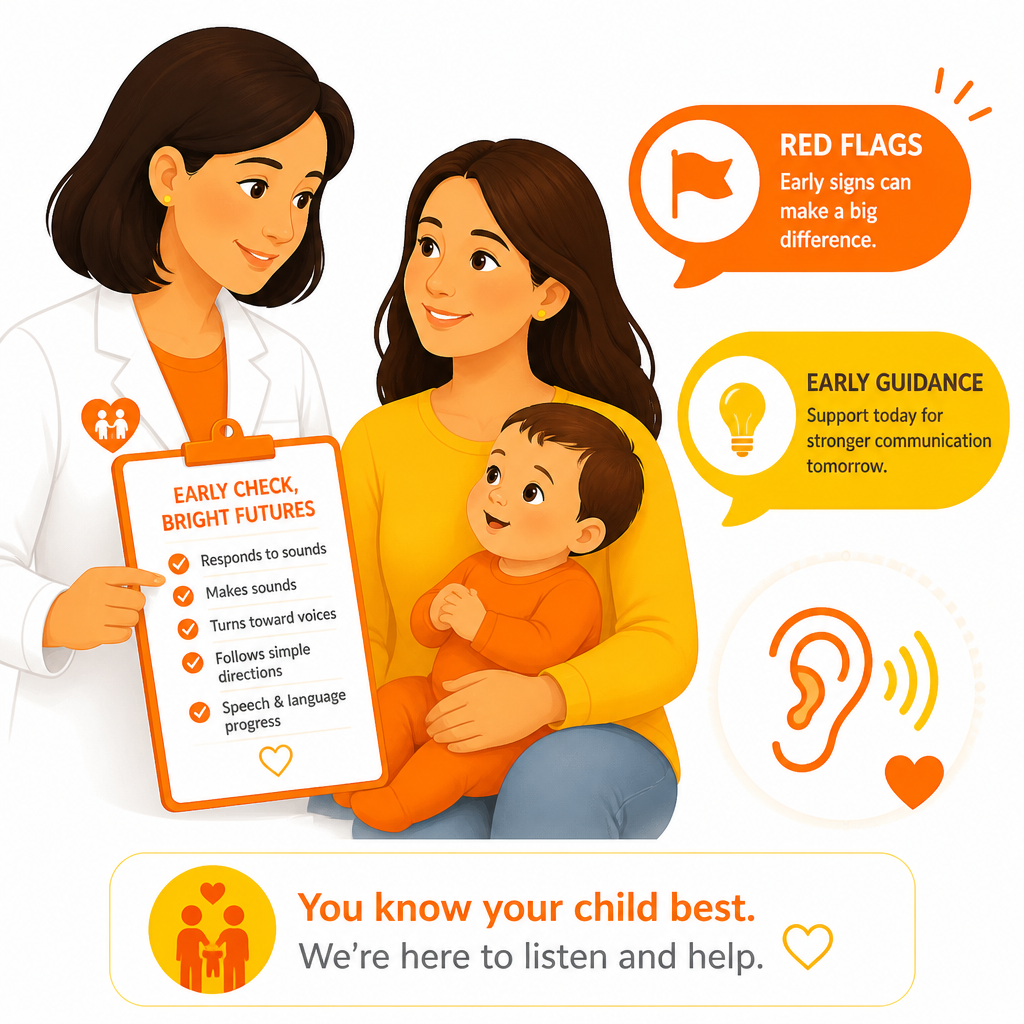
Red flags: when to talk to your pediatrician sooner
Contact Powers Pediatrics if you notice any of the following:
Communication and speech clarity concerns
- Your child’s speech is consistently difficult to understand compared with peers
- Many sound errors persist with little improvement over time
- Your child avoids speaking, becomes frustrated, or seems distressed when trying to communicate
- You notice regression (loss of words or skills)
Stuttering/fluent speech changes
- Stuttering that lasts many months, increases, or causes tension/struggle
- Stuttering that begins after a period of normal fluency
- Your child seems fearful of speaking
Pragmatics / Social Communication concerns
- Trouble with back-and-forth conversation
- Difficulty taking turns or using language to meet social goals
- Limited response to social cues (while hearing seems okay)
- Repetitive or very rigid language patterns that affect interaction
Hearing and comprehension signs
- Frequent ear infections or concerns about hearing
- Appears not to understand you (beyond “not listening”)
- Doesn’t respond to name consistently
“My child talks, but you can’t understand them”—what that could mean
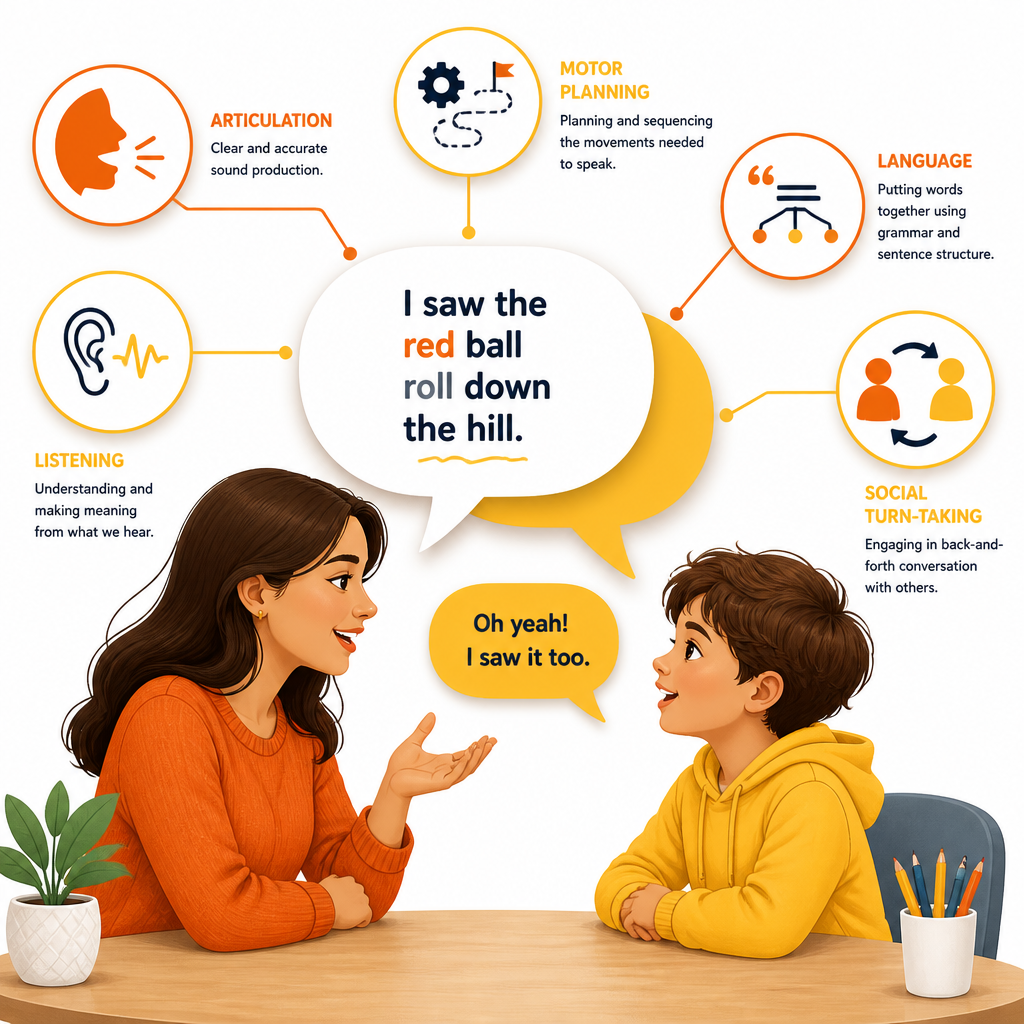
When a child talks yet is hard to understand, the issue may relate to:
- Articulation/phonology (sound production patterns)
- Motor planning for speech (how speech movements are organized)
- Language formulation (building sentences, grammar, and vocabulary)
- Hearing sensitivity or inconsistent auditory access
- Pragmatics / Social Communication (language use in real settings)
A pediatric evaluation helps sort out what’s going on and whether a speech-language pathologist (SLP) evaluation is the next best step.
Stuttering: what parents can do right now
Many children have short periods of disfluency. But it’s worth getting guidance if it’s impacting your child’s comfort.
Helpful approaches
- Slow your own pace slightly and give extra time to respond
- Use calm, supportive eye contact
- Don’t interrupt or “correct” words mid-sentence
- Avoid pressure like “Try again” or “Say it this way”
When to ask for professional support
- The stuttering is persistent or getting worse
- Your child is avoiding speech or looks tense
- You notice strong frustration or anxiety around speaking
Helpful home strategies (while you arrange evaluation)
These don’t replace professional care—but they can support communication:
- Read together and talk about what you see (“I see a dog—what do you see?”)
- Follow your child’s lead (comment on what they’re interested in)
- Use “expansion” (repeat the idea correctly, without demanding repetition):
Child: “Dog run.” Parent: “Yes—the dog is running!” - Reduce background noise during conversation (turn off TV/music)
- Choose play that encourages dialogue (pretend play, simple games, storytelling)

What to expect at Powers Pediatrics
At Powers Pediatrics, we take a whole-child view of Growth & Development. If you’re concerned about speech clarity or social communication, our developmental guidance may include:
- Developmental history and milestone discussion tailored to your child
- Screening and observation of communication patterns
- Guidance on hearing considerations and next steps
- Referrals when appropriate—often to a speech-language pathologist
- Coordination with additional supports when needed (for example, occupational therapy or other developmental resources)
Your goal is not to “fix” your child quickly—it’s to help them communicate confidently and clearly.
Request an appointment online or ask about same-day options when available.
When early help makes the biggest difference
- Reduce frustration and communication breakdowns at home
- Improve clarity and confidence
- Strengthen social communication skills (including Pragmatics / Social Communication)
- Provide clarity for parents—so you know what to do next and why
If you’re worried, that’s enough reason to start the conversation.
Call or message Powers Pediatrics if…
- People often ask you to repeat what your child says
- Your child’s speech clarity isn’t improving with age
- Stuttering is frequent, tense, or distressing
- Social communication seems different than expected
- You’re noticing changes or losing previously gained skills
Call Powers Pediatrics (Orlando, FL), schedule a Developmental Guidance Visit, or ask about telemedicine when available.
Frequently Asked Questions
1 Is it okay to wait and see?
Sometimes a brief period of change is normal—but waiting too long can delay support. If speech clarity is affecting daily life or you’re noticing red flags, it’s reasonable to ask for evaluation now.
2 What if my child is bilingual?
Bilingual children can sound different as they learn multiple languages. That said, speech clarity and communication skills still matter. We can help determine whether what you’re seeing is typical for language learning or needs further assessment.
3 Does stuttering mean something is wrong?
Not always. Many children stutter at some point. However, stuttering that persists, increases, or affects confidence is a good reason to seek guidance from your pediatric team.
4 Should we see a speech-language pathologist?
Often, yes—especially if speech is hard to understand, sound errors are extensive for age, or social communication is impacted. A pediatric visit can help decide the most appropriate next step.
5 Can hearing problems affect speech clarity?
Absolutely. Even mild hearing differences can affect articulation, comprehension, and language development. If there’s any question, your pediatrician can guide next steps.
Next step: get reassurance and a plan
Every child develops at their own pace—but early guidance matters. If you’re concerned about speech clarity, stuttering, or Pragmatics / Social Communication, Powers Pediatrics is here to support your family with compassionate developmental guidance from infancy through young adulthood.
Ask about telemedicine developmental guidance.