

Developmental Problems & Early Intervention for Parents
If you’re concerned your child may not be meeting developmental milestones—or you’re noticing changes in learning, behavior, speech, motor skills, or social skills—you’re not alone. Every child develops at their own pace—but early guidance matters.
Get guidance for:
- Speech/language delays
- Learning or attention concerns
- Motor (movement) delays
- Social-emotional challenges
“Concerned” Is a Good Reason to Ask
Parents often wait—hoping the delay will “catch up.” But early support can help you:
- Understand what you’re seeing (and what’s typical)
- Identify whether evaluation is recommended
- Start interventions sooner when they’re helpful
- Reduce stress by creating a clear plan
If something feels off to you, it’s worth bringing to your pediatric visit.

Developmental Problems: What Parents Usually Notice
Development isn’t only about walking or talking. “Developmental problems” can include concerns across several areas, such as:
- Communication: speech clarity, understanding language, back-and-forth interaction
- Social skills: eye contact, play skills, sharing interests, interacting with others
- Motor skills: coordination, balance, fine motor control (grasping, using utensils)
- Learning/thinking: following directions, attention, curiosity, problem-solving
- Behavior and regulation: frequent meltdowns, extreme frustration, sleep issues, difficulty transitioning
- Growth and milestones: not meeting expected milestones for age
Milestones by Age (What to Watch For)
Milestones can vary, but these are common “watch areas.” If your child is not progressing in multiple areas, or you’re worried about a clear change, consider an evaluation.
Birth–12 months: Communication & Connection
- Limited response to sounds or voice
- Few attempts to communicate (gestures like pointing/waving)
- Not making progress in babbling or early words
- Limited eye contact or social engagement
- Delays in rolling, sitting, reaching, or transferring objects
12–24 months: Words, Play, and Movement
- Not using words or gestures you’d expect for this stage
- Limited understanding of simple directions
- Minimal pretend play or shared enjoyment
- Ongoing trouble with coordination or fine motor milestones
- Social challenges that don’t seem to improve
2–3 years: Language, Behavior, and Social Interaction
- Speech is hard for others to understand most of the time
- Difficulty following simple instructions
- Limited interaction with peers or caregivers
- Frequent frustration or big behavior difficulties that are hard to manage
- Regression (loss of skills you previously saw)
Preschool (3–5 years): Learning Readiness & Emotional Skills
- Speech delays affect daily communication
- Trouble with transitions, rules, or play with others
- Challenges understanding emotions or responding to social cues
- Difficulty with learning basics (letters/sounds/pre-reading readiness)
- Motor delays impact dressing, drawing, or physical play
School-age: Skills, Attention, and Social Learning
- Ongoing academic struggles or attention difficulties
- Trouble with reading/writing, math concepts, or organizing tasks
- Social challenges with peers
- Speech/language needs or pragmatic communication concerns
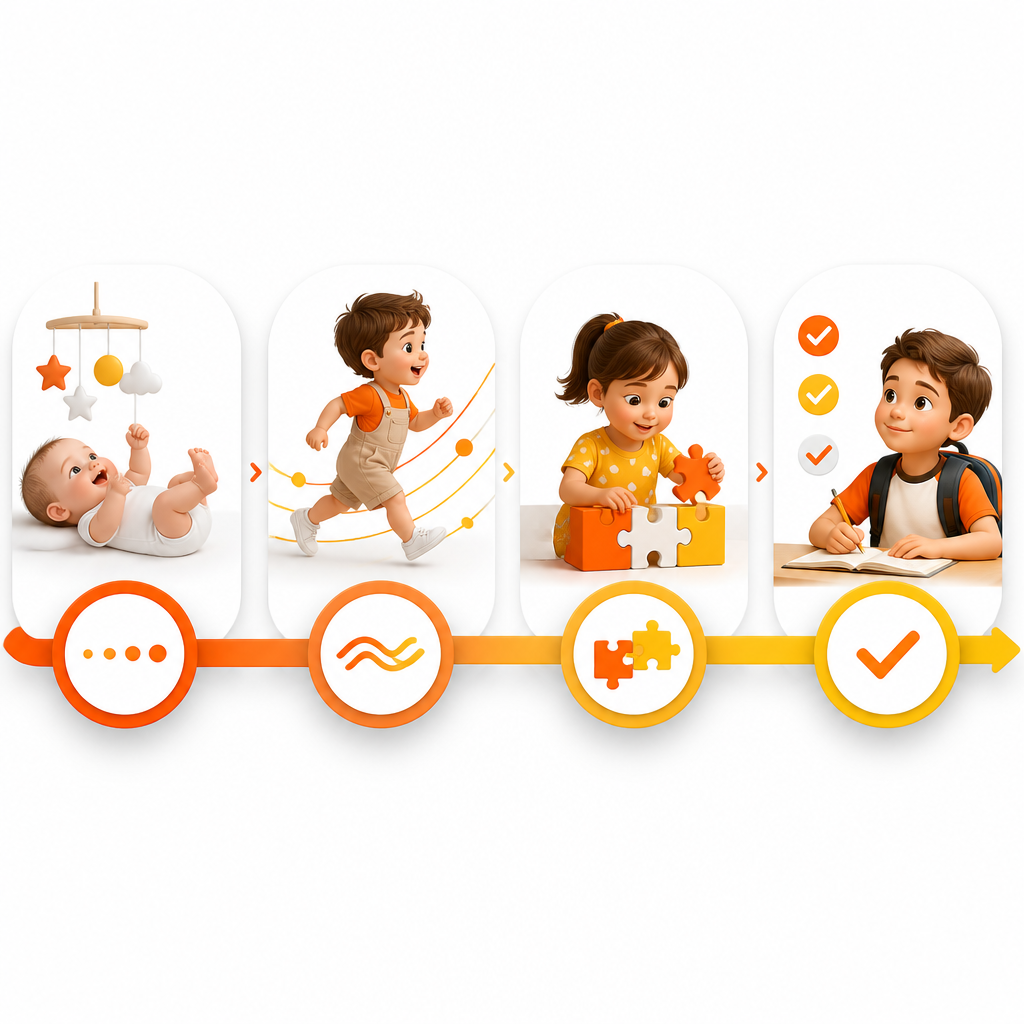
If your child is **not progressing in multiple areas**, or you’re worried about a clear change, consider an evaluation.
When to Talk to Your Pediatrician (Simple Decision Guide)
Reach out to Powers Pediatrics if you notice:
- Your child is not meeting milestones or seems delayed in multiple areas
- Progress has slowed or you’ve seen regression
- You’re concerned about communication, social interaction, learning, or behavior
- The concern is persistent—even if you’re unsure “how much” is enough to act
Tip: You don’t need a diagnosis to start the conversation. A focused evaluation plan can come first.
A focused evaluation plan can come first
You don’t have to wait—bring your concerns to a pediatric visit so your child can get a clear plan.
- Review of medical history, growth, and family observations
- Developmental milestone guidance at routine visits
- Developmental screening to better understand concerns

How Powers Pediatrics Helps (Developmental Guidance First)
At Powers Pediatrics, we combine caring primary care with developmental support for children and families in Orlando, FL. Depending on your child’s needs, we may provide:
- Developmental milestone guidance at routine visits
- Developmental screening to better understand concerns
- Review of medical history, growth, and family observations
- Referrals for additional evaluations or therapy services when appropriate
- Support connecting families to community resources (including early intervention pathways)
Key Terms to Know in Early Intervention (So You Feel Confident)
Learning the vocabulary can make the process less overwhelming. Here are common terms parents hear when exploring services:
Support services for young children with developmental delays or who are at risk.
Testing/assessment to understand your child’s strengths and needs.
The criteria used to determine whether a child qualifies for EI services.
A plan that outlines goals and services based on your child’s needs and your family’s priorities.
The professional delivering services (examples include speech-language pathologists, occupational therapists, physical therapists, and others depending on the plan).
Screening = quick check for potential concerns. Evaluation = deeper assessment when concerns are present.
Parents help shape goals and strategies so supports fit daily life.
Your permission is typically required before evaluation and services begin.
Sometimes there is a person/role that helps organize services and follow-through.
Refer a Child to EI: A Step-by-Step Guide for Parents
If you’re wondering how to take action, here’s a straightforward path to get the process started:
Step 1: Talk to your pediatrician
Bring your concerns to Powers Pediatrics. We can help you understand what you’re seeing and the next steps, including how to support a referral request.
Step 2: Request an EI referral/evaluation
To refer a child to EI, contact your local Early Intervention program and ask for an evaluation due to developmental concerns. Many families start this by:
- Calling the EI intake line in their area, or
- Completing an online referral request if available, or
- Asking the pediatrician to provide documentation that supports the request
Step 3: Share details that help evaluators
Be ready to discuss:
- What you’ve noticed (communication, behavior, motor skills, social interaction)
- When you first noticed concerns
- Any regression or loss of skills
- What has helped (and what hasn’t)
- Your child’s medical history and therapies tried (if any)
Step 4: Consent and evaluation planning
If the program moves forward, you’ll typically be asked to give consent for the evaluation and scheduling.
Step 5: Review results and develop an IFSP (if eligible)
If your child qualifies, you and the team develop an IFSP that focuses on goals and services built around everyday routines—at home and in community settings when appropriate.
Step 6: Ask how services will fit your life
A good EI plan should be practical. Ask:
- How often visits will occur
- Where services will happen
- How progress will be measured
- How you’ll be supported between visits
You don’t have to “wait” for a diagnosis to pursue an evaluation.
Parent Training & Support: Skills That Help at Home (Not Just in Therapy)
A big part of early intervention is equipping parents with strategies that work in real life. Parent coaching and training programs often focus on:
- Strengthening positive interactions
- Using consistent routines
- Promoting communication through everyday moments
- Helping manage challenging behavior with practical steps
- Coaching emotional regulation and play skills
At-home support matters, and it can improve outcomes—especially when parents are active partners in the plan.
If you’re looking for practical tools, ask Powers Pediatrics what resources may fit your child’s needs and age.
What is Social-Emotional Learning? (And Why It Matters for Development)
What is Social-Emotional Learning? Social-Emotional Learning (SEL) is the process of helping children develop skills in:
- Recognizing and naming emotions
- Managing emotions and behavior
- Building healthy relationships
- Learning appropriate social responses
- Developing empathy and problem-solving
When SEL skills are delayed or hard for a child, parents may notice:
- Big meltdowns or frequent difficulty calming down
- Trouble understanding social cues (tone, facial expressions, turn-taking)
- Limited shared play or reduced interest in connecting
- Difficulty communicating needs beyond behavior
- Stress around transitions, changes, or new environments
SEL at home: quick strategies that help
- Name the emotion (“You seem frustrated—let’s try again.”)
- Model calm regulation (slow breaths, simple phrases)
- Practice turn-taking with short, structured games
- Use visual routines (picture schedules can reduce stress)
- Reinforce desired behavior with specific praise (“Nice sharing!”)
SEL isn’t “extra”—it’s part of how children learn, communicate, and connect.
Frequently Asked Questions
Can my child be referred to early intervention without a diagnosis?
Yes. EI often begins with concerns and an evaluation—not necessarily a diagnosis first.
What if I’m worried but I’m not sure it’s “serious”?
That’s common. If you’re concerned about milestones or regression, it’s worth discussing. Early support can clarify what’s going on and guide next steps.
Is early intervention free?
Many EI services are provided with low or no cost to families, but specifics can vary by location and program. Your local EI system can confirm details.
How long does it take to get an evaluation?
Timelines vary. The best move is to start the referral process as soon as possible so you’re not waiting while concerns grow.
What happens during a pediatric developmental visit?
You can expect a review of developmental history, growth, behavior, and concerns. Depending on your child, we may use developmental screening tools and discuss what supports or referrals may help.
Take the Next Step With Family-Centered Care
If your child’s development concerns feel overwhelming, you don’t have to handle it alone. Powers Pediatrics is here to support families with compassionate pediatric care, developmental guidance, screenings, and referrals when needed.
- Schedule a developmental visit with Powers Pediatrics (Orlando, FL)
- Request an online appointment
- Ask about developmental concerns during a telemedicine visit
Powers Pediatrics can provide developmental screenings, practical next steps, and referrals when needed—so you can feel more confident and supported.