

Multilingual Speech & Language Development Milestones
For bilingual and multilingual families, it’s common to wonder: Are my child’s speech and language delays, or are they learning more than one language? The reassuring answer is that every child develops at their own pace—and many multilingual language patterns are normal.
This guide helps you understand speech & language development in multilingual learners, know what milestones to watch for, and recognize when early guidance from a pediatrician is the right next step.
Understanding Multilingual Learners: What’s “Normal” in Speech & Language?
Multilingual children may show patterns that look unusual at first, but often reflect healthy language learning. Here are common examples:
1) “Mixing” languages is often typical
Children may use words from both languages in the same sentence (known as code-switching or mixing). This can happen as they build vocabulary across languages.
2) Progress may not look the same in each language
A child might have more words in one language than another, especially depending on who they spend time with and which language is used at home, daycare, or school.
Key idea for families: speech and language growth should be considered across all languages, not just one.
3) Comprehension may grow before speaking
Many multilingual toddlers understand more than they can say. A child may respond to routines, directions, or questions even if their spoken vocabulary seems limited.
4) Different exposure can affect timing
If your child is:
- learning a new language later,
- hearing one language much more frequently,
- or switching settings (home vs. childcare),
language milestones may shift—but communication can still develop in a typical way overall.
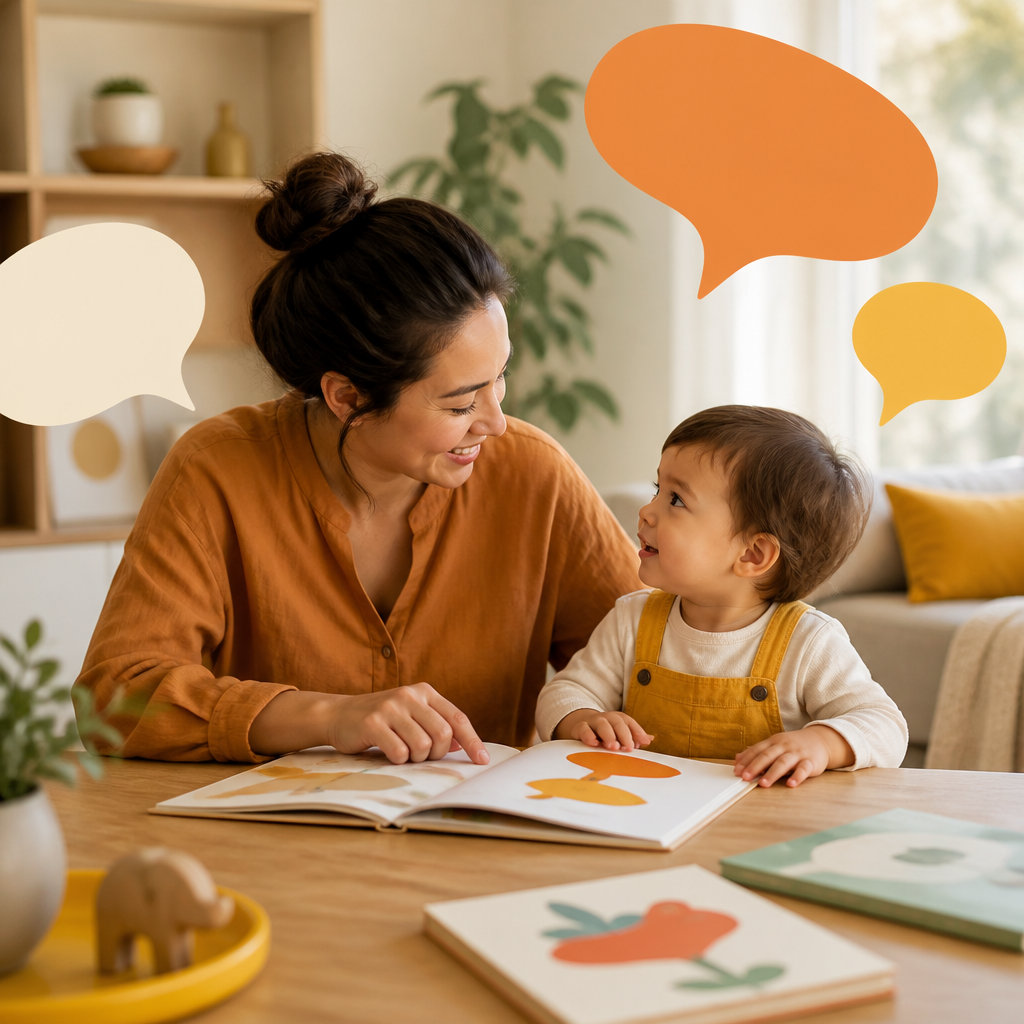
Speech & Language Development Milestones (What to Expect by Age)
Milestones help you understand typical development. With multilingual learners, it’s especially important to look at total communication—words, gestures, eye contact, and ability to understand routines—in each stage of growth.
Birth to 12 months
What’s typically developing
- Responds to sounds and voices
- Shows back-and-forth communication (cooing, babbling)
- Uses gestures (reaching, waving) as part of communication
Family note: Babbling and sounds may vary depending on language exposure, but frequent attempts to vocalize are a good sign.
Consider talking to a pediatrician if you notice:
- No babbling or vocal play by around 12 months
- A major lack of response to sounds/voices you expect your child to hear
12 to 18 months
What’s typically developing
- Uses a small number of words (in one or both languages)
- Understands common words and phrases (names, “come here,” “bye-bye”)
- Communicates needs through words, sounds, and gestures
Consider talking to a pediatrician if you notice:
- Very few/no words (in any language) by about 16 months
- Loss of previously used sounds, gestures, or communication
18 to 24 months
What’s typically developing
- Starts combining words (for example, “more milk” or similar combinations)
- Uses simple phrases or word patterns to communicate
- Understands simple directions (often with context)
Multilingual reality: Some toddlers may use fewer words in one language but expand quickly when both languages are considered.
Consider talking to a pediatrician if you notice:
- Limited communication across both languages combined
- Difficulty being understood and not using other communication methods (gestures, pointing, eye contact) to make needs known
2 to 3 years
What’s typically developing
- More word combinations and short sentences
- Speech becomes clearer over time
- Increasing ability to follow simple two-step routines (with consistency)
Consider talking to a pediatrician if you notice:
- Speech is consistently hard to understand for people who know your child well
- Your child rarely attempts to communicate verbally or nonverbally
- Persistent frustration around communication that doesn’t improve with interaction
3 to 5 years
What’s typically developing
- Longer sentences and more storytelling or explaining
- Growing vocabulary and improved grammar (even if errors remain typical)
- Increasing speech clarity, though accents and differences remain normal in multilingual learners
Consider talking to a pediatrician if you notice:
- Ongoing trouble understanding common instructions at home or school
- Speech that is frequently not understood even by familiar adults
- Concerns about social communication (for example, limited back-and-forth interaction)
School age
What’s typically developing
- More complex language: explaining ideas, answering questions, and understanding classroom language
- Continued growth in clarity and grammar in all languages
Consider talking to a pediatrician if you notice:
- Persistent difficulty with understanding or expressing ideas
- Struggles that affect participation in class or peer interactions

Red Flags: When to Talk to a Pediatrician About Speech & Language Development
Every child learns language differently, but early evaluation matters when there are consistent concerns. Consider making an appointment if you notice any of the following:
- Regression: loss of words, sounds, or communication skills
- Significant difficulty communicating needs in any language (not just one)
- Limited understanding: your child often doesn’t respond to common words/directions over time
- Hearing-related concerns: frequent ear infections or not responding as expected
- Speech clarity that doesn’t improve: other people consistently can’t understand your child as they get older
- Difficulty in multiple settings: concerns continue at home *and* in childcare/school
For Families: How Pediatric Care Supports Understanding Multilingual Learners
When families bring speech or language concerns to a pediatric clinician, a helpful evaluation usually starts with understanding your child’s communication and language environment.
What a family-centered developmental visit may include
- Developmental history: when speech started, how languages are used at home/school, and daily communication patterns
- Observation: how your child communicates using words, gestures, eye contact, and responsiveness
- Screenings: quick checks to look for patterns that may benefit from next-step support
- Hearing review: because hearing impacts speech and language learning
- Referrals when needed: speech-language evaluation and developmental services if concerns are significant
Why language context matters
Multilingual learners may show uneven progress across languages. Clinicians aim to consider the child’s total communication and how language exposure supports development—especially when deciding whether a speech-language delay is present.
What You Can Do at Home to Support Multilingual Speech & Language
There’s no single “right” method to support bilingualism, but these strategies can strengthen communication:
1) Talk, read, and narrate throughout the day
Use both languages you want your child to learn. Describe what you’re doing (“We’re washing hands”), what you see, and how things feel.
2) Follow your child’s lead
If your child points, looks, or makes a sound, respond and expand naturally:
- Child: “da!”
- Adult: “Yes—dog! The dog is running!”
3) Avoid pressuring for perfect wording
Correcting too often can reduce confidence. Instead, model the correct sentence briefly and move forward.
4) Keep routines consistent
Predictable routines (meals, bath time, bedtime stories) support language learning through repetition and context.
5) Support comprehension, not just speech
Ask questions your child can answer and give choices (“Do you want the blue cup or the red one?”).
6) Encourage communication in every language your child uses
If your child uses a word in one language to make a need known, respond with warmth and continue the conversation—language grows through meaningful interaction.

School and Childcare: Partnering When You Have Concerns
If you’re worried about speech & language development at preschool or daycare, consider sharing observations with teachers. Helpful points to bring up:
- What languages are used in the classroom vs. at home
- Whether your child participates in group routines
- How your child responds to instructions and questions
- Whether the concern affects learning, friendships, or confidence
If formal supports are needed, school teams often use language-aware approaches to support learning and communication.
FAQs
1) Will my multilingual child’s speech always be behind?
Not necessarily. Many multilingual children meet milestones within a typical range when you consider development across all languages. Uneven word growth between languages can be normal.
2) Should I stop using one language at home to help speech?
In most cases, it’s better to keep family routines and communication natural. If there are specific concerns, a pediatric clinician or speech-language professional can help you decide the best plan for your household.
3) Is it normal for my child to mix languages?
Yes. Language mixing is common and can be part of how children learn vocabulary and grammar across languages.
4) How do I know if it’s a language delay vs. learning two languages?
Consider whether your child shows progress in overall communication (understanding, gestures, attempts to speak) and whether concerns persist across settings and time. Red flags like regression or significant difficulty understanding may warrant early evaluation.
5) What if my child speaks one language much better than the other?
That can be typical when language exposure varies. If you notice concern in overall communication—especially understanding and ability to communicate needs—talk to a pediatrician.
6) Can speech therapy help multilingual children?
Speech-language support can be helpful when there are true speech or language difficulties. Clinicians can guide families on strategies that support communication across languages.
Next Steps: Get Developmental Guidance From Powers Pediatrics
If you’re a parent who’s concerned your child may not be meeting speech & language milestones—or you’ve noticed a change in communication—early guidance can help you move forward with clarity.
Learn more about developmental support at Powers Pediatrics and how we can help identify next steps through screenings, guidance, and referrals when needed.
Request an appointment for developmental milestone guidance in Orlando, FL, and bring your questions about understanding multilingual learners and speech & language development.
Conclusion
Multilingual speech and language development can look different from monolingual timelines—and that difference can be completely normal. Still, when you see persistent red flags, early support matters.
If you’re unsure, Powers Pediatrics is here to provide family-centered developmental guidance—so you can feel confident about what’s typical, what to watch next, and what steps may help your child thrive.